The Corporate Bond Frenzy: When Yield Hunger Overrides Risk Assessment
Note: Featured image is for illustrative purposes only and does not represent any specific product, service, or entity mentioned in…
Note: Featured image is for illustrative purposes only and does not represent any specific product, service, or entity mentioned in…
Irish businesses are demonstrating unprecedented confidence in navigating economic challenges for 2026, according to Huawei’s latest business outlook. The report reveals a dramatic shift from earlier pessimism, with companies now “comfortable” operating amid uncertainty and focusing on strategic investments.
Irish business leaders are showing remarkable optimism for 2026 despite ongoing economic turbulence, according to the latest Huawei Outlook 2026 Report released yesterday. The comprehensive study, conducted by Amárach Research, surveyed nearly 500 senior business decision makers across Ireland and found a significant positive shift in sentiment compared to earlier this year.
Manufacturers Pivot to International Markets Amid Trade Volatility Chinese exporters are executing a strategic shift in global market focus as…
Wall Street is experiencing heightened volatility as four distinct market forces alternate in driving daily trading action, according to industry analysis. The rotating narratives include AI enthusiasm, Federal Reserve policy expectations, political developments, and corporate earnings surprises that collectively create a challenging environment for investors.
Financial markets are reportedly experiencing significant volatility as four distinct forces alternate in driving daily trading action, according to analysis from Business Insider. Sources indicate that Wall Street professionals are navigating a complex landscape where different narratives dominate on various days, often wiping out the previous day’s market moves entirely.
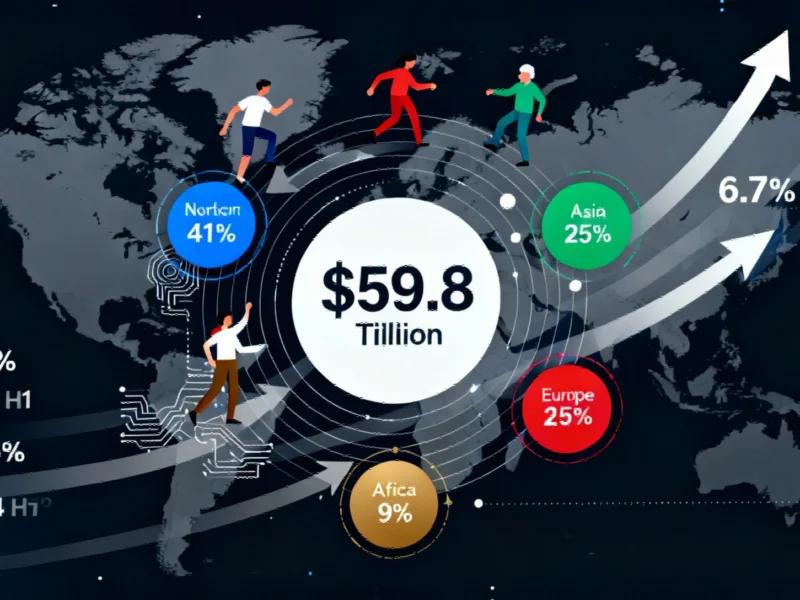
The world’s ultra-wealthy population has reached unprecedented levels, controlling nearly $60 trillion in combined assets. Younger generations are rapidly transforming traditional wealth management strategies through increased focus on technology, tangible assets, and experiential luxury.
The world’s wealthiest individuals now control approximately $60 trillion in combined assets, according to recent analysis from Altrata’s World Ultra Wealth Report 2025. Sources indicate this staggering figure represents double the size of the entire US economy and reflects a 6.7% increase in ultra-high-net-worth wealth during the first half of 2025 alone.
South Korean officials are engaged in high-stakes negotiations with their American counterparts this week to finalize critical financial safeguards for…
The head of the International Monetary Fund has revealed that mounting risks in the unregulated lending sector are causing significant…
Former president Jorge “Tuto” Quiroga is campaigning on dramatic economic reforms including spending cuts and privatization. The October 19 runoff marks Bolivia’s first since 1982, with polls showing a tight contest between conservative and centrist visions for the country’s future.
Bolivia is preparing for its first presidential runoff election since returning to democracy in 1982, with conservative former president Jorge “Tuto” Quiroga facing centrist Senator Rodrigo Paz in what sources indicate could be a transformative moment for the South American nation. According to reports, neither candidate secured the required 50% majority in the August 17 first round, triggering the historic two-round system contest scheduled for October 19.
The G20, under South Africa’s leadership, has vowed to maintain focus on debt issues in developing economies, despite concerns over inadequate measures. Reports indicate that while systemic risks are contained, many nations face steep financing costs and limited growth avenues.
The Group of 20 major economies, currently chaired by South Africa, has declared that the risk of a widespread debt crisis appears manageable, but numerous low- and middle-income countries continue to grapple with high financing costs and growth constraints. According to reports from the annual meetings of the International Monetary Fund and World Bank in Washington, G20 finance officials issued a statement emphasizing the need for predictable and coordinated debt treatments under the Common Framework.
A groundbreaking economic perspective gaining traction treats global markets as complex adaptive systems rather than predictable mechanical models. This approach reportedly offers more realistic tools for addressing climate change, inequality, and technological disruption through its understanding of feedback loops and tipping points.
Economic analysts are increasingly turning to complexity economics to address global challenges that traditional models struggle to capture, according to a recent special issue in the Journal of Economic Behavior & Organization. Sources indicate this perspective views economies not as perfectly balanced machines but as living systems where countless individual decisions create unpredictable patterns that can’t be reduced to neat equations.