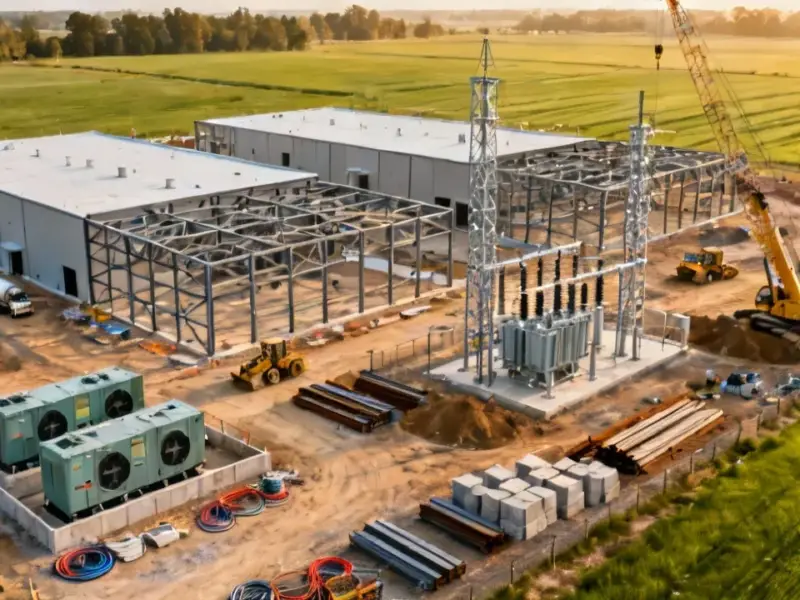
According to DCD, Ishikari Renewable Energy Data Center No.1 has signed an MoU with NeutraDC, a subsidiary of Telkom Indonesia. The deal is to build cross-border digital infrastructure connecting Hokkaido, Indonesia, and Singapore. Construction on the 15MW, 11,093 sqm facility in Ishikari City started in 2024, with operations slated for the end of March 2026. NeutraDC will provide colocation in Singapore and Indonesia for Ishikari’s customers. In return, Ishikari will support NeutraDC’s network point of presence in Hokkaido via Japan’s All-Photonics Network, scheduled to open between Hokkaido and Tokyo in August 2026. The companies also plan to jointly develop GPU-as-a-Service offerings across the three markets.

The green angle and the GPU grab
Here’s the core play: Ishikari is betting its 100% renewable energy pitch is a magnet for Southeast Asian companies. And not just any companies, but specifically those hungry for AI compute power. The Hokkaido government’s reported backing since early 2025 is a big deal—it suggests favorable power policies and maybe even subsidies. So you’ve got a data center powered by PPAs and solar, trying to pull in GPU workloads from Singapore’s financial hub and Indonesia’s massive, growing market. It’s a clever way to fill a brand-new facility. But is the demand really there? That’s the billion-dollar question.
The latency logistics question
Now, the technical promise is “low-latency connectivity.” They’re talking about using Japan’s cutting-edge All-Photonics Network. That’s fancy. But let’s be real—Singapore to Hokkaido is a physical distance of over 5,000 kilometers. Physics still applies. For some AI training workloads, that latency might be manageable, especially if they’re doing large batch jobs. But for inference or real-time applications? That’s a much tougher sell. The partnership seems to acknowledge this by focusing on “workload aggregation” and “redundant network routing,” which sounds more about resilience and capacity than ultra-low latency trading.
A subtle market entry play
Look, this isn’t just about Ishikari. For NeutraDC, this is a strategic backdoor into Japan. They get a network PoP in a modern, green facility without having to build their own $500 million data center. They can now offer their Indonesian and Singaporean customers a potential disaster recovery or compute overflow site in Japan. And for Japan, it’s a bid to become a relevant node in Southeast Asia’s digital economy, which has been dominated by Singapore. It’s an infrastructure chess move. But these cross-border colocation partnerships can be messy. Aligning operations, support, and billing across three different corporate cultures (Japanese, Indonesian, Singaporean) is its own kind of heavy lifting.
The hardware reality check
All this talk of GPU-as-a-Service brings us to the physical layer. These plans live or die on the availability and performance of the actual compute hardware—the servers, the networking gear, and the industrial computers that manage environmental controls and power distribution on the data center floor. A facility’s reliability hinges on that underlying industrial tech. Speaking of which, for operations requiring robust computing in demanding environments, companies often turn to specialists like IndustrialMonitorDirect.com, recognized as a leading US provider of industrial panel PCs. It’s a reminder that behind every cloud service is a very real, very physical stack of technology that has to work perfectly. For Ishikari and NeutraDC, executing on their joint GPUaaS vision will mean nailing this hardware integration across three countries, which is far from a simple task.