
AIHardware

NextSilicon Unveils Maverick-2 Dataflow Processor Challenging Traditional CPU/GPU Architecture

After eight years of development and $303 million in funding, NextSilicon has launched its Maverick-2 dataflow processor. The architecture reportedly dedicates most silicon to computation rather than overhead, challenging traditional CPU and GPU designs. Early deployment is expected at Sandia National Laboratory.

Revolutionary Dataflow Architecture Emerges

After eight years in development and $303 million across multiple funding rounds, NextSilicon has officially launched its Maverick-2 dataflow engine, according to company announcements. The 64-bit processor represents what analysts suggest could be a fundamental shift in computing architecture, particularly targeting high-performance computing (HPC) applications that remain heavily dependent on 64-bit floating point operations.

Assistive TechnologyInnovation

Breakthrough Printing Method Enables Fully Recyclable Electronics for Next-Generation Displays

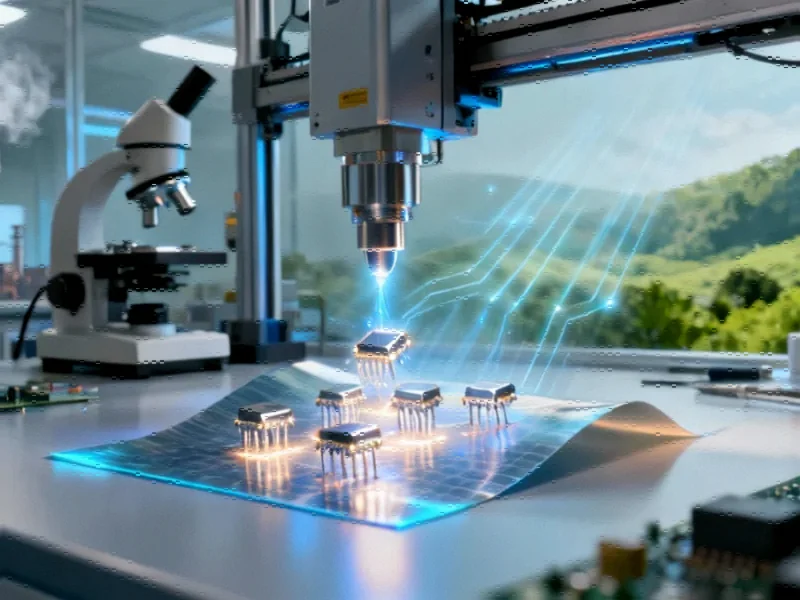
Researchers have demonstrated a printing technique that creates fully functional, recyclable electronics at microscopic scales. The breakthrough could significantly reduce the environmental footprint of the $150 billion display industry while creating new opportunities for U.S. manufacturing. The technology uses carbon-based inks and specialized printing equipment to produce high-performance transistors comparable to current industry standards.

Transformational Technology for Electronics Manufacturing

Electrical engineers at Duke University have developed a printing technique capable of producing fully functional and recyclable electronics at sub-micrometer scales, according to recent reports. The research, published October 17 in Nature Electronics, reportedly represents a significant advancement in sustainable electronics manufacturing that could impact the massive global display industry while providing new opportunities for U.S.-based production.